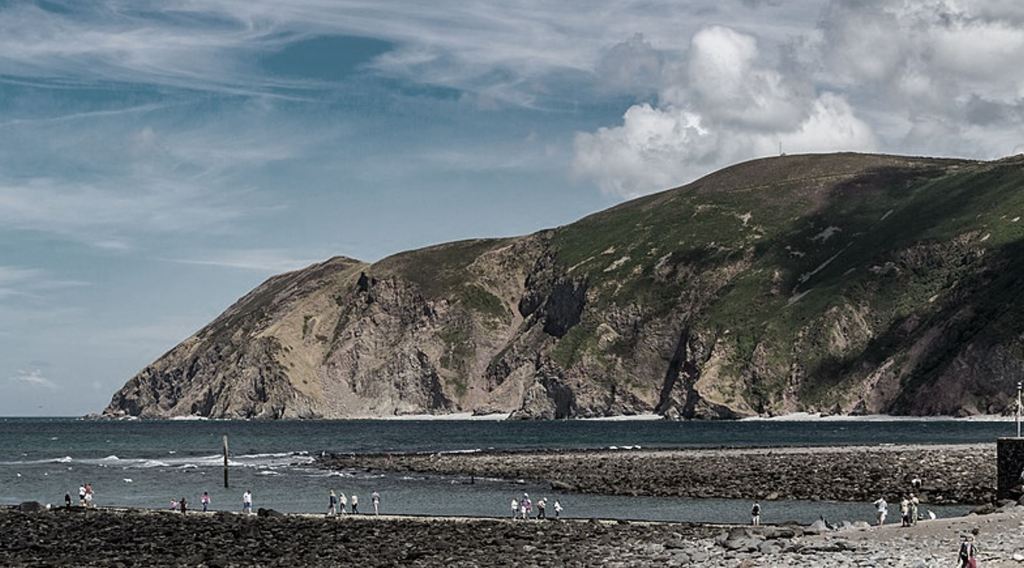
I have just returned from a short holiday in Lynton, North Devon. I have always wanted to visit this place because it is the exact geographical opposite of Porthcawl, across the Bristol channel. For years, I swam in that channel from the Wales-end and observed the ever-shifting cliff-lands of Exmoor: kaleidoscopic maroon and myrtle swirls in constant shifts under coastal lilac cloud. The sun bleeds and spreads from second to second in fractals impossible to capture in words. I have tried to write these cliffs into a poem all my life and have yet to accomplish it.
The other side could not be more different. Porthcawl, for Wales, is flat. Sand dunes form the pinnacle of our elevation and there is no walk in our landscape that would cause calves to sustain and ache anything remotely like the burn of Lynton’s ubiquitous twenty-five degree gradients. Lynton is the opposite and could not be more opposite to Porthcawl. I don’t think I observed a single grain of sand in the place: only rocks. Back home, in Porthcawl I can fudge globules of soft warm sand between flip-flopped toes even in winter. Its coastline, instead of blue lias granite is made of jagged and gaunt steeples of crags. The Valley of Rocks sums it up. But, the colours are the same. The same yellow lichens fan across the Victorian esplanade and the same lilac skies dome the place.
Lynton is curious in that is lacks the generosity of most tourist towns, and it has been a tourist town almost since its inception. These denizens all seem grumpy, painfully gaunt with pinched expression. Those hills are hard. No pleasantries: not a thank you for being there. At no point do you hear a Westcountry accent. The town museum is un-curated and draped in widow-weaved spider web, strewn across displays of everything they have ever owned in no particular order. Nobody is from this place. Instead, the voices are broadly RP or ‘London’. The house prices are as steep as the hills and there is no more vernacular.
There is a funicular railway (only operational in peak season) to elide the impossibly vermicular track between Lynton and Lynmouth (called the Poet’s Path). A publican anecdoted that, when a new resident complained so vociferously on the town Facebook about it, that they were practically laughed out of town. A restaurant owner told me that her mother complained about the steep hills when she came to visit. If her mother is not from here, then nor is she. The hotelier who accommodated us said, when I asked whether the ice was bad in winter, told me, “I don’t know; I am not here”. Peripatetic residents make up the transient citizenship of this place and this is quite the opposite of its opposing town across the channel whose families I can name for generations.
Percy Bysshe Shelley honeymooned in this place with his sixteen-year-old first wife, Harriet Westbrook. Shelley too was a peripatetic resident as early as 1812 and was just passing through. He finished Queen Mab here but by all accounts wrote nothing of significance here otherwise. Perhaps the inhospitality of this place causes writer’s block.
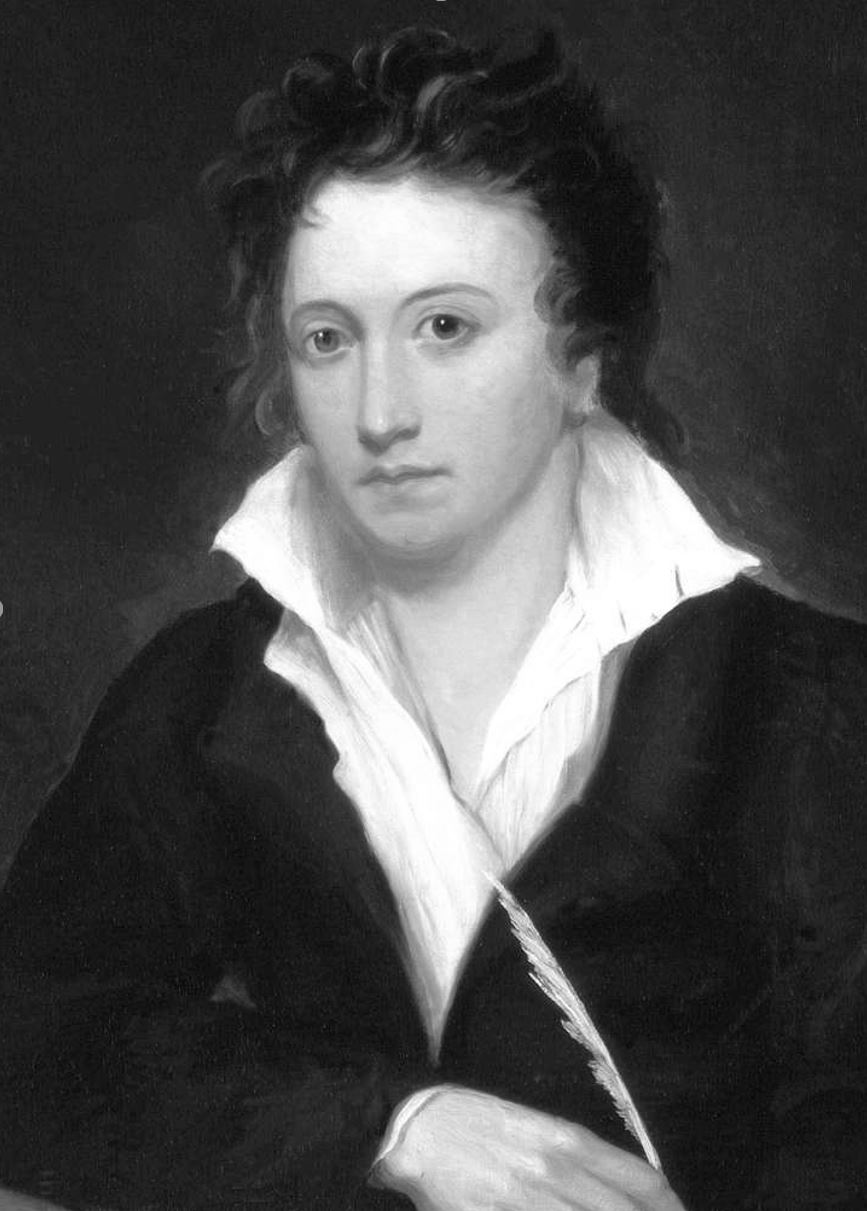
During his time at Lynmouth, Shelley, freshly returned from Paris and the Revolution, and with an entourage almost in production-line efficiency placed propaganda into waxed-sealed bottles and threw them into the channel. Perhaps some made it to Wales. Perhaps some made it to Porthcawl. Perhaps one could still wash up for me to find on Coney Beach. After a revolutionary fly-posting of Barnstable, he and his printer were arrested and Shelley fled to Wales via Ilfracombe. We can’t know where he landed, but it is not implausible that he landed in Porthcawl, the direct opposite of the channel, before making his way to the Elan Valley where his cousin held an estate. Of course, Porthcawl, as we know it now, did not exist then. It would have been Newton Downs. Did Shelley scoon his boat on those ancient sand-duned shores?
The rain-staunched skies cleared and I sat on a terrace of Castle Hill, the highest habitable point in Lynton. Across the channel, I could see Porthcawl lighthouse at least ten times larger than reality. Trecco bay stretched out in a sustained chain of flicker and I could see the gap of darkness caused by Ogmore’s estuary. Pleiadean streetlamps shimmered up the hill in Ogmore-by-Sea. Wenvoe & Saint Hillary TV masts rubric like monolithic envois on the coastline. A plane was landing at Cardiff International. Where did Shelley land his boat? We can never know. Perhaps Porthcawl, and perhaps he grabbed a clod of dune-sand in his grasp to inspire his great Ozymandias.
 Lisa Mansell
Leave a comment