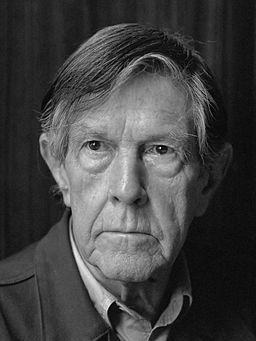
Most people know John Cage as the somewhat cheeky, avant-garde composer of 4’33”, but fewer people know the significant contribution he made to poetry and poetics, recorded over several collections including M: Writings ’67–’72 (1973), Empty Words: Writings ’73–’78 (1979), and X: Writings ’79–’82 (1983).
Cage was a pioneer of procedural, constraint-based and algorithmically generated poetics: a kind of poetry which is composed within a strict confine of rules. One of these algorithmic techniques, called ‘writing through’, entailed a process of selecting the letters which spell out the name of an author then using them as a ‘code’ for selecting words from a novel written by that author, according to strict rules. Cage deployed this procedure for his five ‘write-throughs’ of Finnegans Wake by James Joyce, (Cage mischievously said of this novel, “it’s my favourite book I’ve never read.”) Taking the letters ‘J’ ‘A’ ‘M’ ‘E’ ‘S ‘J’ ‘O’ ‘Y’ ‘C’ ‘E’ as the code, he then applied the process of ‘writing-through’ to Finnegans Wake. The poems were then presented via a reinvention of the ancient mesostich form (pronounced MESS-oh-stick), which Cage called ‘mesostic’. Readers may be already familiar with the acrostic poem, where the beginning letters of each line in a poem form a message or spell out a name; a mesostic does the same thing but with the spelled-out message in the middle of the line. (In case you’re curious, if the code letters are at the end of the line, it is called a telestich).
Cage was also interested in algorithmic process as chance procedures. This time, ‘writing-through’ Thoreau’s Journals. Cage divided the text up into five kinds of material: letters, syllables, words, phrases, and sentences:
“A text can be a vocalise: just letters. Can be just syllables, just words; just a string of phrases; sentences. Or combinations of letters and syllables (for example), letters and words, et. Cetera. There are 25 possible combinations.”
‘Empty Words’, p. 11. (1975)
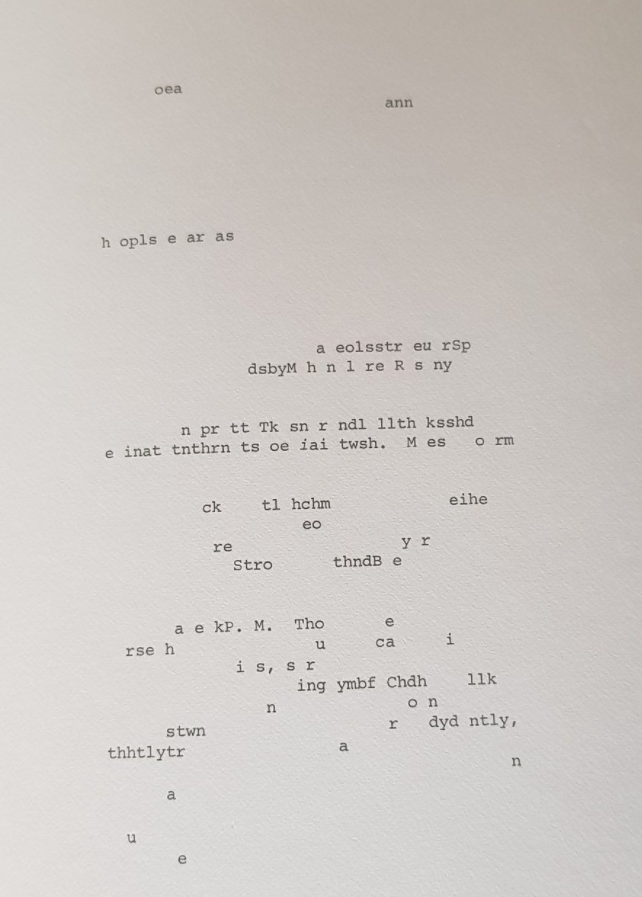
The next stage in this process, after assigning numerical values to these lexical parts, was to use the I Ching, to produce aleatoric combinations of these words, syllables, letters, and phrases. This results in some of the most strikingly avant-garde and beautiful (in my view) poetry which challenges the way we think about language structures, meaning, and representation.
 Lisa Mansell
.jpg)
Leave a comment