
I teach a workshop on psychogeography for my Creative Writing undergraduates and as we approach this topic on the syllabus—still in lockdown—I am forced to rethink things quite a bit. We cannot stroll, detour and dérive around the city and its crinkled, abandoned Victorian alleys like before; we cannot walk the archaeology of chickweed-clung canals, pot-banks, nor the cemetery arced by a gothic lychgate purled in urban lichen. We are, instead, online—scattered around the several regions of the country—staring uniformly at our screens.
Sure—I can teach them about Guy Debord, Rebecca Solnit, Iain Sinclair—but where’s the fun in just a theoretical approach to psychogeography? What does psychogeography mean in a pandemic? And so my thoughts drift to the places where we can go: the home, the threshold, the garden, and the permitted walk to the shops for only essential goods. These ruminations eventually settle on Bachelard’s 1958 work, The Poetics of Space—in particular the two chapters: “The House: From Cellar to Garret. The Significance of the Hut” and “The Dialectics of Inside and Outside”. From the former emerges the idea of finding the centre of a house which has many rooms and a reference to the ‘poetry of the house’:
[T]he house itself, in the family sitting-room, a dreamer of refuges dreams of a hut, of a nest, or of nooks and corners in which he would like to hide away, like an animal in its hole. In this way, he lives in a region that is beyond human images. If a phenomenologist could succeed in living in the primitiveness of such images, he would locate elsewhere, perhaps, the problems that touch upon the poetry of the house. (Bachelard, 2014, p. 50)
What is the ‘poetry of the house’? Is it the “inhabited space [which] transcends geometric space” and its relation to the “the topography of our intimate being’? And how are these things poetic? The house is a ‘metaphorical domain’ and its lyricism flows porous streams of psychic energy between consciousness and daydream in a space—something I align quite closely with psychogeography—and the most important process of this psychogeography (and also in poetry) is the ‘newness of image’, the surprise of noticing the previously unnoticed, the disrupting joy of defamiliarization.
I used to make a habit years ago of defamiliarizing my space. It started in a teenage bedroom where, overnight, I would rearrange the furniture to see the room from a different place. My bed had been positioned in every possible (even impractical) place in the room in order to feel the strangeness of waking somewhere else. My mother claims this is a habit inherited from my Grandmother who would often redecorate and redress a room by the time Mum arrived home from school. It was like coming home to a new house. Some time ago, around the time I bought a house—I stopped. At last, settled in a place permanently enough not to have to arrange my surroundings according to a landlord’s list of rules or face the possibility of moving again soon, I began to curate my space. My rooms are somewhere between trendy backstreet café and dishevelled charity shop in a mostly elegiac Pre-Raphaelite palette with hauntolgies of lurid ‘60s kitsch: a turquoise, portable record player, a framed print of “Tina” by J.H. Lynch above the hipster wood-burner fireplace—what you’d expect for a poet—I embrace the cliché.
But the house has become decentred in the repurposing of spaces during ‘working from home’ lockdowns, and thus, old spaces become, once again, defamiliarized. My kitchen has become now a different room. It is still the place where meals are prepared, but it is also now my office, and my classroom, the kitchen table my desk—but more on desks later. The office upstairs (which I suppose is really a spare bedroom without a bed) is where my office used to be, but now it belongs to Mr. Octopthorpe—he too is at home and teaching online. We cannot teach in the same space for fear of interruption. Computer science and codes might seep into the consciousness of my poetry students and his pupils might begin to code software with prosody instead of C#. Come to think of it, this isn’t such a bad idea. We both spend hours per day reading lines of code, after all.
I am not the first to look inwards to the home for psychogeographical kicks during lockdown. In my research I stumbled upon Nadia Idle’s article, ‘Psychogeography at Home’ first published Autumn 2020 in Dazed Magazine in which Idle sets the parameters for a psychogeographical ‘walk’ at home:
I decided that the overgrown garden would be the wrong territory – its impending bramble scratches would detract from the drifting state I needed to conjure. But it would also be cheating. A dérive had to be urban, full of lines, hard surfaces and shadows. There had to be textures of the man-made variety. Dérives are supposed to be just that, drifty, but for a proper lockdown experience, I had to set the parameters of travel within four walls.
and then documents the experience of a derive under the table:
I shoved the 1970s chair on wheels out of the way and got on my back, pulling myself under. The atmosphere was dark and cool. I could hear the neighbours watering their voluptuous hanging baskets through the open garden door, but I felt a world away from them. I reached both hands up and felt the underside. The wood was rough, no – I traced my fingers in circles to check – smooth, just unfinished. Distinctly underside. Functional, but not presentable. I pressed my palms up against the long metal beam that formed the extension mechanism. It was nice and cool. Very satisfying. I stroked it some more, until I spotted some writing from the corner of my eye. I scooted back. WTF was this? Printed in that weird cargo stencil font was 954-306-3 ACCOLADE 12 BY DREXEL 260 – curious! I moved my head to the left a bit and saw blue crayon scribbles over the writing. I felt a pang.
A hand flew to my heart. I must have done that when I was four years old. (Idle, 2020)
This is a poetic space: a new and defamiliarized space—under the table new ‘deskscape’ unfolds.
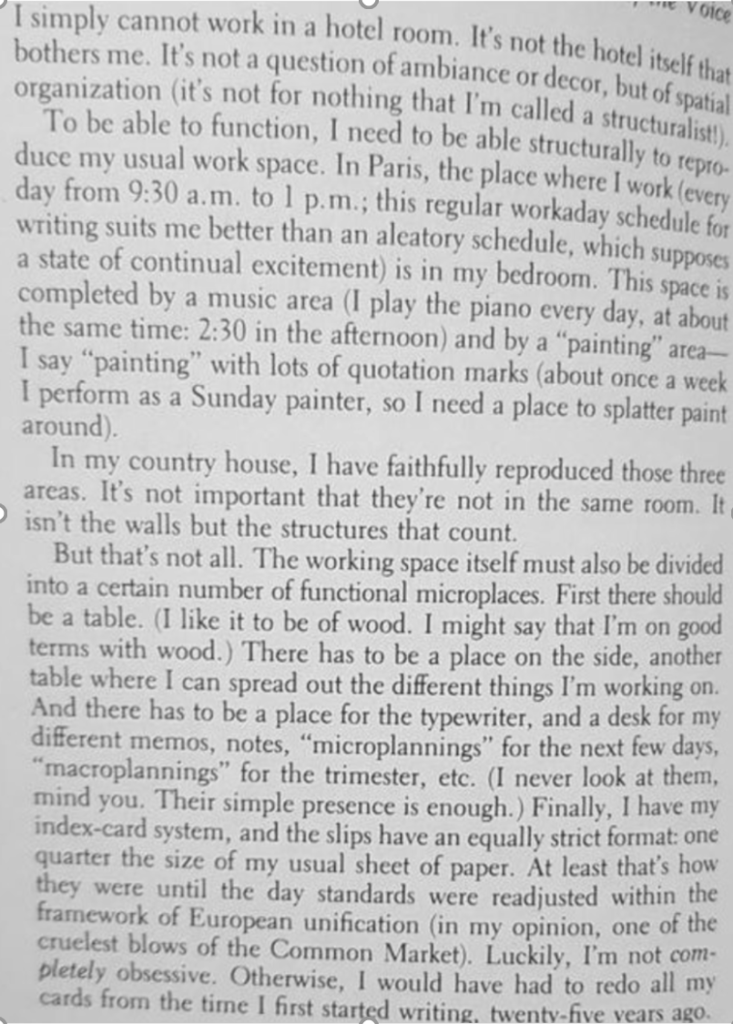
Which brings me around—eventually—to desks. The desk, which used to be the kitchen table—has become the centre of my house. It’s where I write, work, teach, zoom, and eat. Many writers have documented their desk topologies—from Georges Perec’s obsessive listing of the objects on his desk in Species of Spaces and Other Pieces to Roland Barthes rather decadent arrangement recalled in “An Almost Obsessive Relation To Writing Implements”– a 1973 interview for Le Monde, later published in his collected interviews, The Grain of the Voice, in 1985:
I absorb these texts with nosey fascination. I am rather drawn to this somewhat antiquarian deskology by Archibald Jacob (not enough people are called Archibald anymore) in his 1947 manual Musical Handwriting:
In daylight the illumination should fall on the table from the left; if it comes from the right or the back, your writing arm, or your body, will throw shadows across the paper (if you are right-handed) and your eye will soon become tired and inaccurate; never, if you can possibly help it, sit facing the light, or allow bright sunlight to shine on the paper on which you are writing. With artificial light the lamp (of sufficient but not excessive brilliance) should stand or hang towards the left in the same way; but here an extra precaution is necessary, for even with the light falling from the left, the eyes will soon become dazzled and blurred unless the lamp is at the right angle. The author was puzzled by this for some time, but finally discovered the reason. The heads of notes are, when wet, tiny pools of ink and therefore minute reflecting mirrors. (Jacob, 1963, p.7)
I wonder what Archibald would think of our current predicament. Would he be shocked that we seldom write by hand anymore? Do we think enough about where and how the natural light falls in the house? I wish my words would resemble inky, mirrored note-heads still. What Jacob describes is almost an impossible space today—a psychic hauntology—unless one ventures completely into the vintage; somehow, I don’t think my students would appreciate lectures on the form of calligraphed scriptures in the post. Jacob was also no stranger to global catastrophe and curfewed movement. He writes that the world war led to a paucity of writing materials—but our culture is one of abundance, even in the pandemic. Amazon is just a click away. Even Barthes remarked on his abundance of pens:
Take the gesture, the action of writing. I would say, for example, that I have an almost obsessive relation to writing instruments. I often switch from one pen to another just for the pleasure of it. I try out new ones. I have far too many pens—I don’t know what to do with all of them! And yet, as soon as I see a new one, I start craving it. I cannot keep myself from buying them. (Barthes, 1985, p. 178)
And so we furnish and curate our deskcapes with paraphernalia and ephemera and transpose feeling and emotion into these denizens of the desk. Just as Barthes notes his disdain for Bics (“there is a “Bic style,” which is really just for churning out copy”) I profess my preference for Koh-i-Noor 2B pencils (they smell so good!) or, if I must use a pen, a Pilot Hi-TechPoint 0.7—which I first used at university. We might think this all a bit of romanticised mythologization. Writers love their pens, right? Always eyeing up those Moleskine notebooks in the bookshop, aren’t you? But Barthes calls this an anti-mythological action:
Insignificance is the locus of true significance. This should not be forgotten. This is why it seems to important to me to ask a writer about his writing habits, putting things on the most material level. (Barthes, 1985, p.177)
While we’ve detoured to the subject of mythology, it seems appropriate to end where we began with Bachelard:
“Outside and inside form a dialectic of division, the obvious geometry of which blinds us as soon as we bring it into play in metaphorical domains [. . .] Philosophers, when confronted with outside and inside, think in terms of being and non-being [. . .] Hyppolite spoke of “a first myth of outside and inside.” And he added: “You feel the full significance of this myth of outside and inside in alienation, which is founded on these two terms. Beyond what is expressed in their formal opposition lie alienation and hostility between the two.” And so, simple geometrical opposition is incapable of remaining calm. It is obsessed by the myth. (Bachelard, 2014, pp. 227-228)
In true deconstructionist form, the boundaries between outside and inside are problematized and blended in the pandemic. Insides are defamiliarized and so too is the outside in the ritualistic spacing, two-meters-aparting and scuttling quickly to the shops along most direct route to collect only essential goods. Out there, our pathways and tracks have changed. In here, it’s a whole new world.
 Lisa Mansell
Leave a comment